Godzilla
- By: theartofcinema
- Category: Cult and Classic, Japanese, Science FictionTagged: Godzilla
- November 10, 2025
Godzilla – the great Kaiju – King of the Monsters, star of 38 films; countless comic books, video games and symbol of 20th century pop culture; has been with us since he first roared onto Japanese screens in 1954. Conceived by producer Tomoyuki Tanaka, director Ishirō Honda, and special-effects legend Eiji Tsuburaya, Godzilla was born from the anxieties of post-war Japan—an island nation still reeling from the atomic bombings of Hiroshima and Nagasaki.
Godzilla’s story—a prehistoric creature awakened and mutated by nuclear testing—was a metaphor for the destructive power of the atomic age. The monster was not simply a villain but a tragic figure, embodying both nature’s wrath and humanity’s self-destructive tendencies. The film’s imagery of a city reduced to ashes resonated deeply with Japanese audiences who had lived through similar devastation. Thus, Godzilla emerged not merely as a monster movie but as a national allegory, expressing grief, guilt, and resilience.
Over time, the metaphor evolved. As Japan’s economy recovered and entered its period of rapid growth, Godzilla’s meaning shifted from a symbol of nuclear horror to a protector of humanity, a hero battling other colossal threats. Across nearly 70 years, Toho Studios produced more than 30 films, creating a vast kaiju universe that includes Rodan, Mothra, King Ghidorah, and many others. Godzilla transcended his origins, becoming an ambassador of Japanese popular culture around the world.
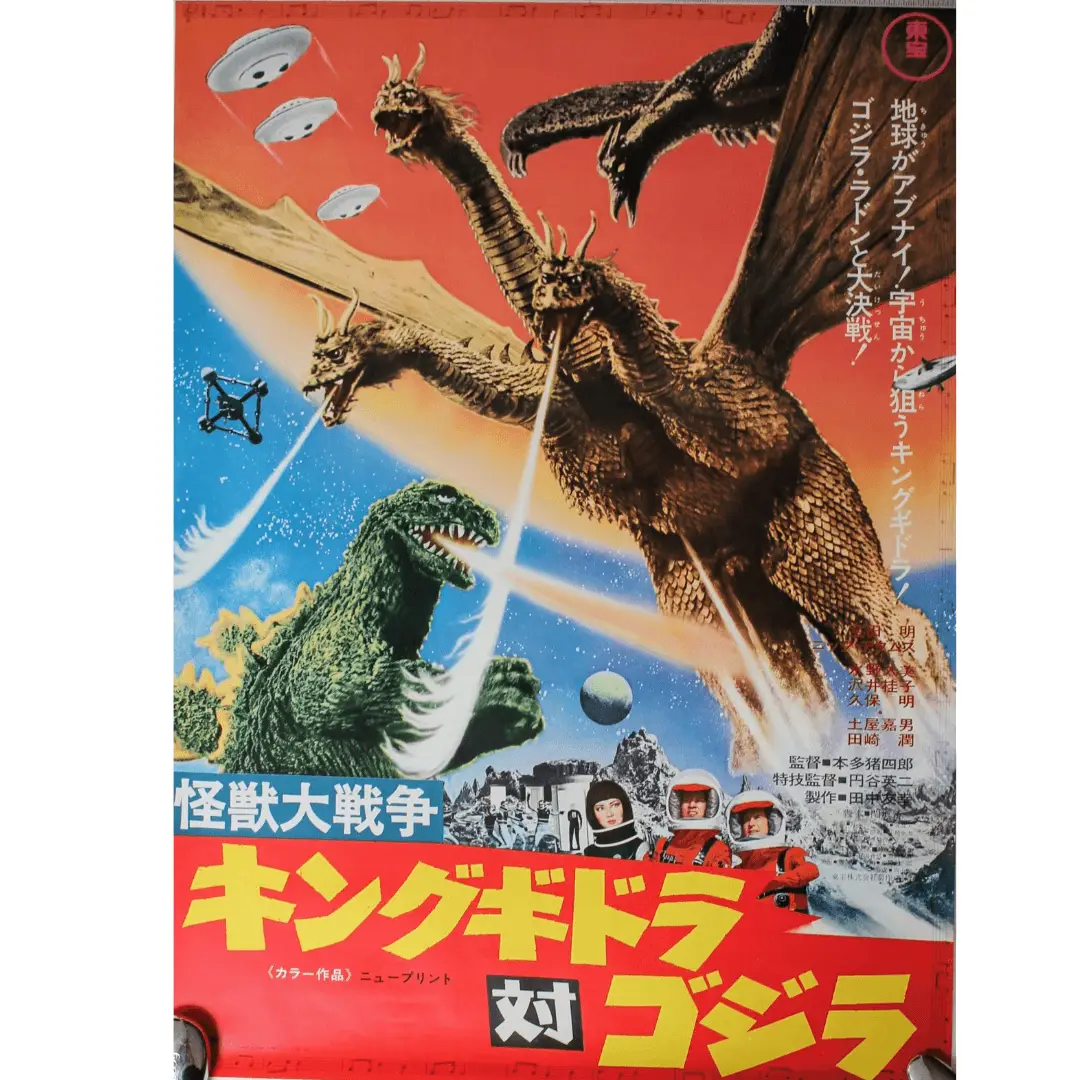
Godzilla vs Monster Zero (Invasion of Astro-Monster)
From original artwork from 1965 this is a re issue poster from 1971. This is one of the most beloved films in the series, marking the second appearance of King Ghidorah, Godzilla’s three-headed nemesis. The story—featuring aliens from Planet X who manipulate Godzilla and Rodan into fighting Ghidorah—bridges science fiction and traditional monster spectacle.
The artwork here is a masterclass in mid-1960s Toho design. The vivid cosmic background, with UFOs and laser beams, underscores the era’s fascination with space exploration and Cold War anxiety. Godzilla’s heroic pose and the astronauts below reflect the franchise’s tonal shift from horror to adventure.
This is a Japanese B2 posters much sought after by collectors worldwide. It has been conservation framed in a lightweight wooden frame and mounted with archival acid free mount.
Available to buy today from our Etsy store or contact us direct.
£545.00
.
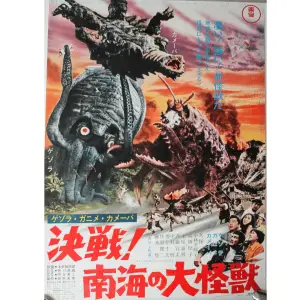
Gezora, Ganime, Kameba: Decisive Battle! Giant Monsters of the South Seas, 1970
This poster is from Space Amoeba, directed by Ishirō Honda and produced by Toho in 1970. Though not a direct Godzilla film, it belongs firmly in the Toho kaiju lineage, featuring three new monsters—Gezora (a giant cuttlefish), Ganime (a massive crab), and Kameba (a giant turtle). The creatures are possessed by an alien entity known as the Space Amoeba.
The artwork here is pure Showa spectacle: a fiery tropical backdrop, monsters mid-battle, and panicked humans fleeing in the foreground. The Japanese typography—large, diagonal, and bright red—adds urgency and kinetic energy. It captures a period when kaiju films were marketed as blockbuster adventure fantasies, appealing to families as much as to monster fans.
In terms of collectability, original 1970 Toho theatrical posters for Space Amoeba are moderately rare, particularly in good condition. A clean B2-size (approx. 20×28 inches).
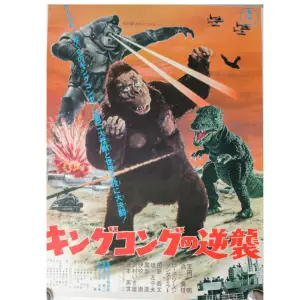
King Kong Escapes, 1967
This poster promotes King Kong Escapes (1967), another Toho production directed by Ishirō Honda. It features the iconic showdown between King Kong, Mechani-Kong, and Gorosaurus—the latter of whom would later appear in Destroy All Monsters (1968).
The design is striking: a hand-painted Kong facing off against his robotic double under a vivid sunset sky, with tanks and helicopters underscoring the military stakes. The glowing eye-beams from Mechani-Kong and the stylized explosions give it a retro-futurist, pulp-sci-fi feel, characteristic of late-1960s Toho posters.
This piece epitomizes the “collage realism” style—blending airbrushed monster art with composited photographic imagery. Such posters were meant to feel both cinematic and hyper-real, bridging the gap between fantasy and propaganda-style spectacle.
Original King Kong Escapes Japanese B2 posters are relatively rare, particularly because of the international licensing between Toho and RKO. Collectors value them between $400–700 USD, with higher prices for near-mint examples.